Psalm 2 – Challenge to prayer and missions
Bybelskool.com se bydraes het vanoggend vasgehaak op die bediener. Jy kan Psalm 104 hier lees.
Ek preek vanoggend in Summerstrand United oor Psalm 2 en stel Veritas College International daar bekend. Hier is dus ‘n bonus bydra oor Psalm 2.
 I want to bring a message from God and share about Veritas.
The Lord placed Psalm 2 on my heart. This message, especially as it is applied in the NT, in the book of Acts, chapter 4 and 13, as well as in Revelation 2, the letter to Thyatira, dovetails nicely with the intent of Veritas to motivate congregations towards prayer and missions.
Claris will read Psalm 2. And then I will give the message and, in the process, also share about Veritas.
Psalm 2
1 Why do the nations conspire (rage)
and the peoples plot in vain?
2 The kings of the earth rise up
and the rulers band together
against the Lord and against his anointed, (Ac 4:25–26) saying,
3 “Let us break their chains
and throw off their shackles.”
4 The One enthroned in heaven laughs;
the Lord scoffs at them.
5 He rebukes them in his anger
and terrifies them in his wrath, saying,
6 “I have installed my king
on Zion, my holy mountain.”
7 I will proclaim the Lord’s decree:
He said to me, “You are my son (Mt 3:17);
today I have become your father (2 Sa 7:14; Ac 13:33; Heb 1:5; 5:5).
8 Ask me,
and I will make the nations your inheritance (Rev 2:26 – applied to us as well in the letter to Thyatira),
the ends of the earth your possession.
9 You will break them with a rod of iron (Ge 49:10; Rev 12:5);
you will dash them to pieces like pottery (again in Rev 2:27; and in Rev 19:15).”
10 Therefore, you kings, be wise;
be warned, you rulers of the earth.
11 Serve the Lord with fear
and celebrate his rule with trembling.
12 Kiss his son, or he will be angry
and your way will lead to your destruction,
for his wrath can flare up in a moment.
Blessed are all who take refuge in him.
Context
Although there is no title for Psalm 2, it is attributed to David in the NT, in Acts 4:25. Paul also quotes from it and calls it the second Psalm in Acts 13:33.
This Psalm, together with Psalm 1, are really important in the book of Psalms. Their combined message is the foundation upon which the entire book of Psalms is built.
Psalm 1 helps us to understand that joy and prosperity are to be found with the Lord and in his community in reading and obeying his Word.
“Blessed is the one whose delight is in the law of the LORD.”
Psalm 2 helps us to understand that this God is all-powerful. He is active on the world stage of peoples, nations, kings, and leaders.
He is
“The One enthroned in heaven.”
- Psalm 1 is therefore the foundation for your personal life with God.
- Psalm 2 is again the foundation for our public life with God.
And this is such a necessary focus for us today when we have to deal with all the conflict in the Middle East, in the Sudan, in the Ukraine and also the turmoil in our own country. With strife and war, with division and destruction.
Psalm 2 gives us the courage to trust God to bring direction in the fickleness of the (international) political world of our communities, and seek refuge in Him, both in our personal life and in the public part of it.
Interestingly, Psalm 1 begins with a beatitude (Ps 1:1):
“Blessed is the man who finds his delight in the law of the Lord.
Psalm 2 ends with a similar beatitude (Ps 2:12):
“Blessed are all who take refuge in Him” (or: “who trust in Him”).
This has led some commentators to think that the two Psalms were originally one Psalm.
Be that as it may, the two Psalms make this point as a whole:
Blessed are all who find their delight in God, and trust in Him.
Exegesis of the Psalm
Psalm 2 is made up of four parts:
1. David starts with his surprise at the unrest and fickleness of public and political life. He exposes the driving force behind it as a rebellion against the Lord and his anointed, in this context, the king of Israel. He says in Psalm 2:1-3:
1 Why do the nations conspire (rage) and the peoples plot in vain?
2 The kings of the earth rise up and the rulers band together against the Lord and against his anointed, saying, 3 “Let us break their chains and throw off their shackles.”
This is what is happening in every conflict on the international stage as well as in our own country. People do not want to live according to the revelation of God, the love for Him and the love for your neighbor. That leaves them at each other’s throats and wanting to serve their own interests above all. As we can see in our own government that speaks out about the Palestine conflict, but not about the conflict in Sudan or Iran. Because it suits their political interests.
2. David knows, however, that God is not at the mercy of the wiles and whims of his adversaries, after all He lives in heaven. He says in Psalm 2:4-6:
4 The One enthroned in heaven laughs;
the Lord scoffs at them.
5 He rebukes them in his anger
and terrifies them in his wrath, saying,
6 “I have installed my king
on Zion, my holy mountain.”
The Psalm talks about David here. Against all odds God has put on the throne of Israel a man after God’s own heart, his chosen one, David. The One enthroned in heaven therefore laughs at the nations. He proved his power by confirming king David on the mountain of God, on Zion. This rebellion was therefore stillborn. And God has made an everlasting covenant with David, which we know was eventually fulfilled in the Lord Jesus Christ, as the congregation in Acts 4 prayed.
3. King David, God’s anointed one, then praise God for this promise in the Psalm, because God has included the whole earth to be under his rule. Psalm 2:7-9 says:
7 I will proclaim the Lord’s decree:
He said to me, “You are my son (echoed in Mt 3:17 at Jesus’ baptism);
today I have become your father.
This was promised in 2 Samuel 7:14; and acknowledged by the NT believers in various places as a depiction of Jesus (i.e. Acts 13:33; Heb 1:5; 5:5).
Then God gives this all-encompassing promise in verse 8-9:
8 Ask me,
and I will make the nations your inheritance
the ends of the earth your possession.
9 You will break them with a rod of iron
you will dash them to pieces like pottery.
This was a promise that was given to the David and the Messianic line, but therefore also fulfilled in the Messiah, the Lord Jesus Christ, when He was born in Bethlehem, the city of David.
4. David therefore warns the kings and rulers of the earth to serve the Lord with awe and thus avoid his wrath.
10 Therefore, you kings, be wise;
be warned, you rulers of the earth.
11 Serve the Lord with fear
and celebrate his rule with trembling.
12 Kiss his son (submit to his authority), or he will be angry
and your way will lead to your destruction,
for his wrath can flare up in a moment.
Blessed are all who take refuge in him.
What a wonderful blessing: “Blessed are all who take refuge in Him,” which is especially an encouragement to the servants of the Lord wherever they find themselves in this world.
Message and meaning
I want to touch on two of the many uses of Psalm 2 in the NT to help us understand its message also to us. The first is about prayer. The second about missions.
1. The first challenge is about prayer. When Peter and John together with the entire community of believers were threatened by the Jewish Council they chose to pray.
We read in Acts 4 that the threat was to stop preaching the gospel in the Name of Jesus Christ. But Peter and John stood firm and said:
“Salvation is found in no one else, for there is no other name under heaven given to mankind by which we must be saved.” (Acts 4:12)
Then they gathered in the upper room in Mary’s house, the mother of John Mark – that wrote the gospel of Mark later in life – and prayed that they may be strengthened in their resolve to evangelize the world. With a quote from Psalm 2 they cried out to the Lord:
“Why do the nations rage and the peoples plot in vain? The kings of the earth rise up and the rulers band together against the Lord and against his anointed one.”
Then they connected the message of Psalm 2 with the rebellion of Herod and Pilate together with the Gentiles and the people of Israel against God’s holy servant, Jesus. And they prayed:
“Now, Lord, consider their threats and enable your servants to speak your word with great boldness. Stretch out your hand to heal and perform signs and wonders through the name of your holy servant Jesus.”
And what happened?
Luke tells us in Acts 4:
After they prayed, the place where they were meeting was shaken. And they were all filled with the Holy Spirit and spoke the word of God boldly.
That is the spirit that must endure in the congregation. To boldly ask of God, because He has given us the promise in Psalm 2:
“Ask of me, and I will give you nations as an inheritance, the ends of the earth as a possession.”
This is then the first challenge to you. To pray without ceasing that God will give us the nations as an inheritance, the ends of the earth as a possession.
This is a promise that God made to his Son Jesus. This is a promise that we can also appropriate for ourselves. To pray for the nations. To pray that the Gospel will reach everyone. And that the turmoil in this world will not hinder the spread of the Gospel.
After this in the unfolding of the story of the church in Acts we see this prayer answered! We see it answered in the missionary work of Peter (Acts 10), Paul (Acts 13 ff) and the rest of the apostles.
2. The second challenge to you is about missions. When Paul preached to the people of Antioch in Pisidia (Turkey) on his first missionary journey, he warned the Jews in the synagogue that were resisting the Gospel. And we read in Acts 13 that he challenged them, based on Psalm 2, that they should repent, to be reconciled to Jesus.
When they did not react positively, he declared that the light of God is now for all people and that he would now focus his energies on the Gentiles.
And we read:
“When the Gentiles heard this, they were glad and honored the word of the Lord; and all who were appointed for eternal life believed.”
That is the goal of our prayer and witness in this world. So that everybody can hear the word of the Lord. So that everybody that have been appointed for eternal life can believe.
Promise
There is a glorious promise in the letter to Thyatira in Revelation 2 that also use Psalm 2 as its foundation. I give this promise to you as a motivation to stand firm in prayer and missions.
In his letter Jesus admonishes the church of Thyatira to sort out the immorality issues of the prophetess Jezebel and to keep doing what the Word tells them to. And then Jesus uses Psalm 2:8 as a promise that can motivate them to do the work of the gospel in this world:
26 To the one who is victorious and does my will to the end, I will give authority over the nations—27 that one will rule them with an iron scepter and will dash them to pieces like pottery’(quoted from Psalm 2:8)—just as I have received authority from my Father. (Rev 2:26-27)
Amen
Veritas
 With the explosion of Christianity in the Majority world traditional approaches and methods for training in ministry can be difficult due to financial and local restrictions. It is generally accepted that at least two million pastors in the Majority World need training in how to interpret the Word, apply it in their situation and minister the Gospel to their people.
Veritas has pioneered a system of Competency-Based Theological Training through which students acquire skills in our non-formal Ground Phase training (Modules 1–4), then to a higher level of competence in our formal Australian accredited Diploma training, to eventually the same skills at our Postgraduate training level in a MDiv and DMin or PhD program accredited in the USA Educational Department.
Veritas College’s Foundation Phase training is extremely cost-effective, as the training is run from a strong volunteer base, with support from Veritas staff. Our training approach is extremely cost effective as we do not invest in buildings but use locally available venues. It is not only cost effective, but it means that we equip local people to train others.
We currently have 14 642 people in training in Sub-Saharan Africa. For instance;
| Malawi | 4,270 |
| Mozambique | 2,089 |
| South Africa | 3,032 |
| Uganda | 1,689 |
| Zambia | 2,504 |
We are also expanding into Madagascar with translation into Malagasy and training.
In total we have 27 500 people in training throughout the world.
Through this endeavor we ensure that the training in each country becomes more sustainable and even in war situations may continue as we have seen in Syria and recently in Sudan.
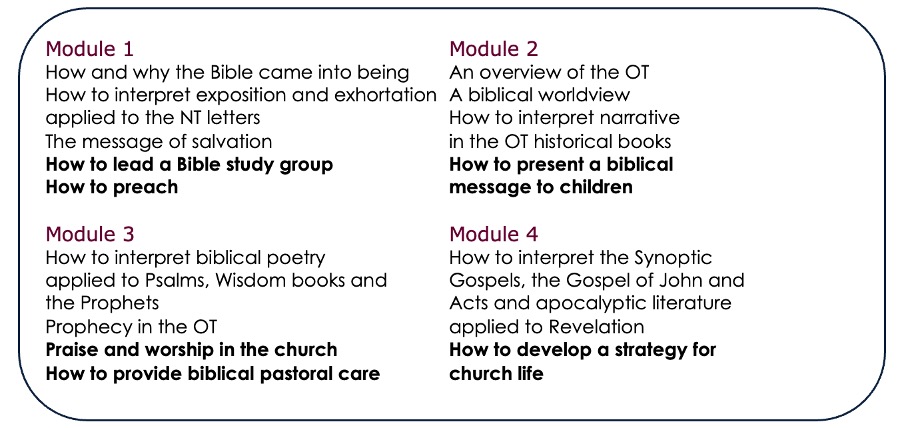
What we offer you here in Summerstrand is the module training.
We focus on three things in our training: knowledge, competencies, and character.
We help you to:

Claris and Shirley van der Merwe can be contacted for the training here.
I am also available to especially train facilitators.
We have four modules that can be presented locally in the church and also online.
Discover more from Bybelskool
Subscribe to get the latest posts sent to your email.

Onlangse kommentaar